Define the fragrance claim and review all ingredients
A fragrance-free brief should define the proposed claim, identify ingredient functions and account for the remaining formula odor. Review supplier composition, labeling requirements and finished-product suitability before translating the position into artwork.
Brands should state what they mean by the claim: no ingredient added primarily to perfume the product, no masking fragrance, or another clearly justified standard. Then review every raw material and supplier disclosure against that definition. Do not infer that fragrance-free automatically means non-allergenic or suitable for every sensitive-skin consumer.
Develop for comfort not a slogan
An effective formulation brief describes the preferred texture, ingredient exclusions if justified, target use and desired sensory profile. It may also request specific tests to support claims such as “suitable for sensitive skin,” which should not be treated as self-evident from the absence of fragrance.
| Risk area | Practical action |
|---|---|
| Intrinsic raw-material odor | Evaluate samples over time, not just on day one |
| Fragrance cross-contamination | Review line cleaning and material segregation controls |
| Botanical extracts | Examine documentation, odor and claim suitability |
| Consumer claims | Define supporting evidence before label approval |
| Destination-market labeling | Check applicable allergen and ingredient rules |
Pay attention to changing allergen rules
The European Commission maintains specific guidance on fragrance allergen labeling. The EU's expanded framework includes important transition and application milestones, so brands should check current rules and the final formulation before artwork sign-off. Even a product with no separately added fragrance needs accurate ingredient declarations and an appropriate safety assessment.
Validate the finished product
An unscented prototype may expose natural raw-material odors more clearly than a fragranced product. Evaluate consumer acceptability under realistic storage conditions; check formula stability, microbiological protection where appropriate and pack compatibility. Avoid claims such as “zero irritation” or “100% safe for sensitive skin,” which cannot be guaranteed for all people.
Apply current EU allergen disclosure to the complete formula
The European Commission explains that allergens covered by Annex III require individual labeling above 0.001% in leave-on products or 0.01% in rinse-off products. Its current guidance states that noncompliant products may no longer be newly placed on the EU market from 31 July 2026, with qualifying earlier stock subject to the transition ending 31 July 2028. Review the applicable conditions for the actual shipment.
A fragrance-free positioning does not eliminate the need to review allergen contributions from the complete composition. Obtain suitable supplier data and evaluate the finished formula, including functional materials and botanical blends. Separately review whether the fragrance-free statement accurately describes ingredient functions and likely consumer understanding. An odor is not by itself proof that perfume was added, while absence of noticeable odor is not proof that all fragrance-related substances are absent. Keep claim review and ingredient-disclosure review connected but distinct.
Frequently asked questions
Does “fragrance-free” mean the product has no smell? No. Raw ingredients may have their own odor.
Can botanical extracts be used in fragrance-free skincare? Potentially, depending on the role of each material and the meaning of the final claim. Review supplier documentation and market guidance.
Does fragrance-free mean nobody can react to the product? No. Individual reactions can involve ingredients other than added perfume. A fragrance-free statement should describe the product accurately and should not be presented as a universal guarantee against allergy or irritation.
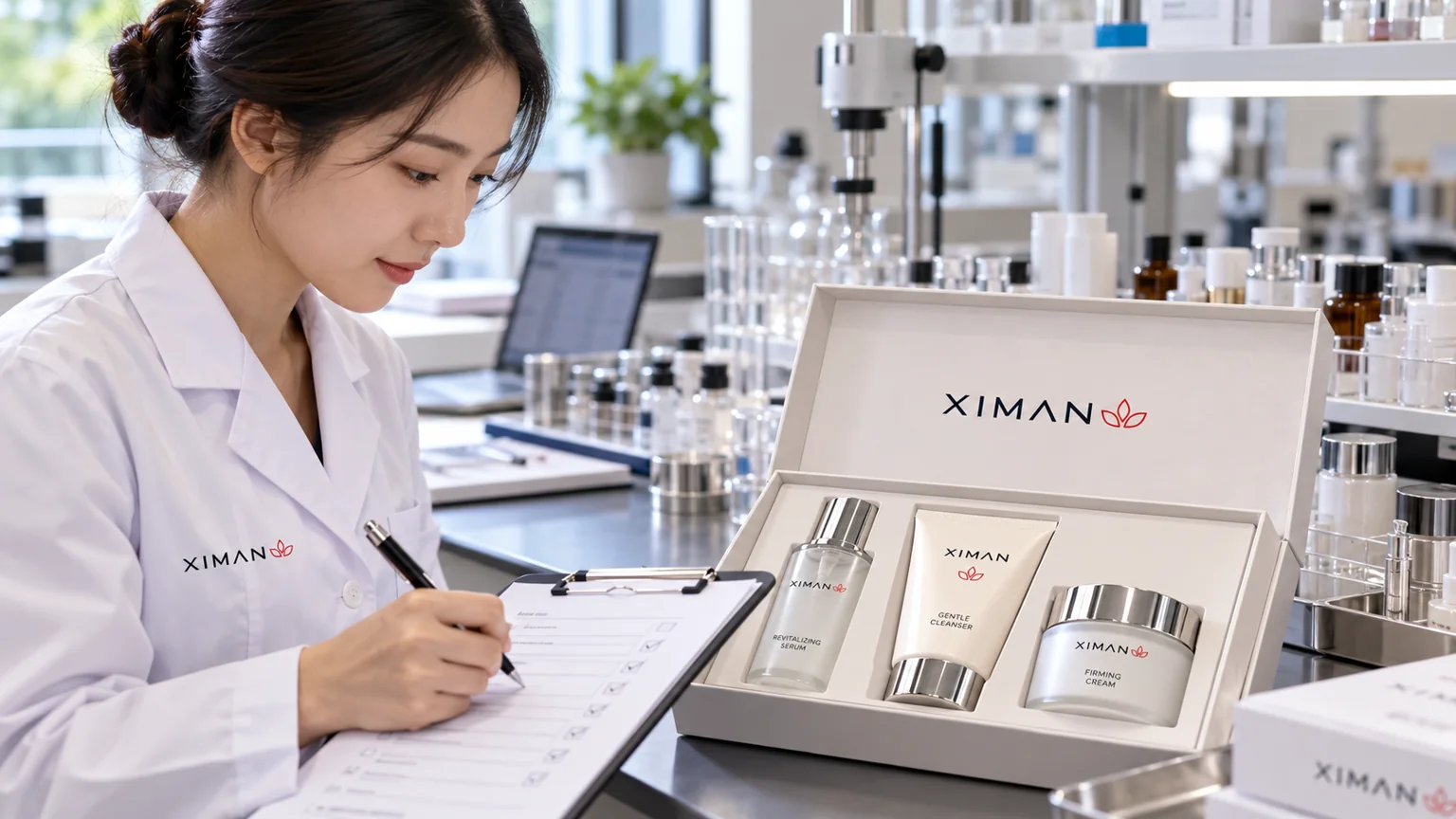
Next step: Ask XIMAN to translate your fragrance-free positioning into a written ingredient, sensory and claims checklist before prototype approval.
Sources & review date
- European Commission fragrance allergen labeling ↗ · Checked 2026-10-14
- EU claims criteria ↗ · Checked 2026-10-14
Sources and check dates are listed above; applicability depends on the destination market and product conditions.
Discuss your market and product
Share your destination market, product category, project stage and estimated quantity to plan the next step.