Qualify the material that will actually be purchased
A familiar ingredient name can cover commercial materials with different composition, concentration, carriers and specifications. Qualification should identify the exact supplier grade used in the approved formula. An INCI name helps with labeling, but it does not establish that every material carrying that name is technically interchangeable.
Start with the supplier and product code, relevant composition information, specification, handling conditions and batch documentation. Check whether distributors repackage the material or assign different lot codes. The factory should be able to connect the received container to the original supplier's records without relying on a sales description.
Separate identity quality and performance questions
Identity asks whether the material is the intended substance or blend. Quality asks whether it meets its agreed specification. Performance asks whether it behaves suitably in the particular finished formula. A favorable answer to one does not settle the others.
For a botanical blend, for example, the extraction medium and solids basis can influence comparisons. For a polymer or surfactant solution, concentration and relevant functional properties can alter processing. These differences should be understood before comparing the price of one kilogram from two vendors. A lower price for a more dilute blend can reverse the apparent saving on an equivalent-content basis.
If illustrative Material A contains 20% of a defined component and costs $20/kg, its component cost is $100/kg before other differences are considered. Material B containing 10% at $12/kg gives $120/kg on the same basis. This arithmetic does not establish that A is the better purchase: carriers, impurities, compatibility and supplier reliability still need assessment.
Build a specification around the relevant risks
| Material information | What it helps determine |
|---|---|
| Chemical or blend identity | Whether the grade matches the approved formula |
| Defined content or assay | Whether strength comparisons use the same basis |
| Relevant impurities or residuals | What requires safety and quality assessment |
| Microbiological information | How the material contributes to product risk |
| Storage and retest information | Whether inventory remains suitable before use |
| Change notification | Whether future deliveries preserve the approved assumptions |
Do not ask for every imaginable test on every ingredient. The specification should follow the material's characteristics, intended use and applicable market review. A supplier COA should relate to the lot delivered and state interpretable methods or results. If a result is expressed as a limit, check what that limit means rather than turning it into an absolute absence claim.
FDA's inspection resource includes controls for raw-material identity, lot and acceptance status. Its role here is a technical reference for the procurement conversation; the qualification decision remains specific to the factory's system and product. [1]
Check what happens at receipt and during storage
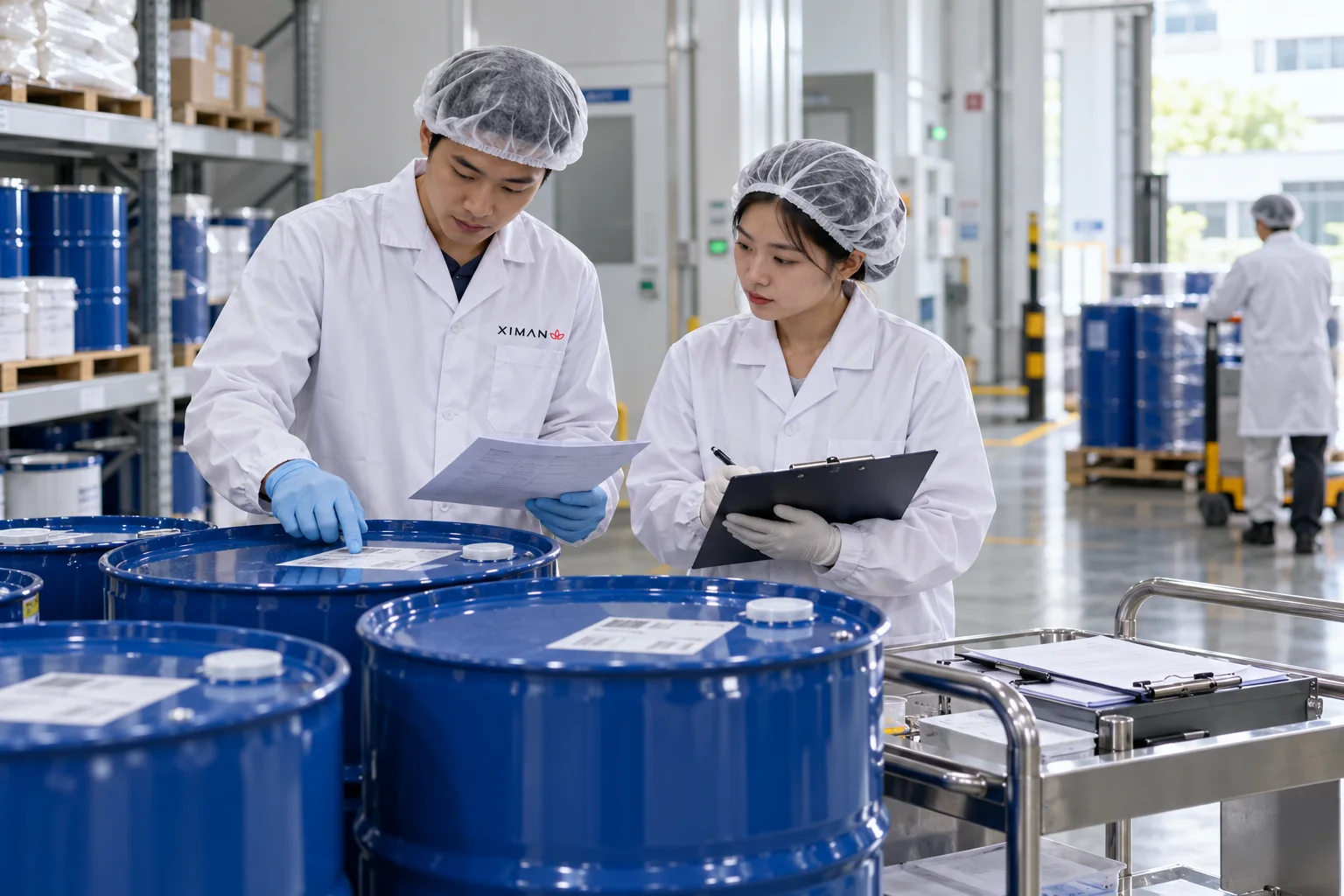
Supplier approval does not mean every subsequent delivery is released automatically. Ask how receiving inspection verifies container condition, identity, documentation and appropriate storage. Distinguish quarantine, approved and rejected material in records and physical handling.
Opened containers also need controls. A material originally supplied in suitable packaging can deteriorate or become contaminated after repeated use. Review the factory's approach to container closure, dispensing tools, internal labels and storage history. Where a supplier specifies a retest date rather than an expiry date, determine how continued suitability is assessed instead of treating the terms as synonymous.
For materials sensitive to temperature or moisture, shipment conditions may form part of the receiving review. The question is whether the actual lot remained suitable, not whether the courier delivered it quickly.
Evaluate substitutions in the finished formula
When a proposed replacement differs from the approved grade, compare composition and relevant behavior before applying the same addition rate. A material with the same INCI name may change viscosity, clarity, odor, color or preservation assumptions. The change can also alter the ingredient statement when the commercial blend contains different supporting components.
Identify what existing data remains applicable and what needs further assessment. Keep pilot observations and necessary product testing connected to the change request. A substitution should not become invisible merely because marketing continues to use the same hero-ingredient name.
The most useful brand agreement defines which changes require notification or prior approval and how confidential composition can reach the qualified reviewer. This lets procurement respond to supply problems while preserving a clear link between the approved formula and the materials actually used.
Frequently asked questions
Does a raw-material COA prove finished-product performance? No. It reports designated characteristics of a particular material lot. Formulation compatibility, finished-product safety and commercial claims require their own relevant assessment.
Can the factory buy the same INCI ingredient from any supplier? The approved material specification and change process determine what is acceptable. The INCI name alone is insufficient evidence of equivalence.
Should a supplier's retest date be treated as an expiry date? Not automatically. Understand the supplier's meaning, supporting information and the factory's procedure for evaluating suitability before use.
Project discussion: Ask XIMAN how your critical raw materials will be specified and which supplier changes would require your review before production.
Sources & review date
- [1] FDA cosmetic GMP guidelines and inspection checklist ↗ · Checked 2026-10-14
- [2] FDA Product Testing of Cosmetics ↗ · Checked 2026-10-14
- [3] ISO 22716 Cosmetics good manufacturing practices overview ↗ · Checked 2026-10-14
Sources and check dates are listed above; applicability depends on the destination market and product conditions.
Discuss your market and product
Share your destination market, product category, project stage and estimated quantity to plan the next step.