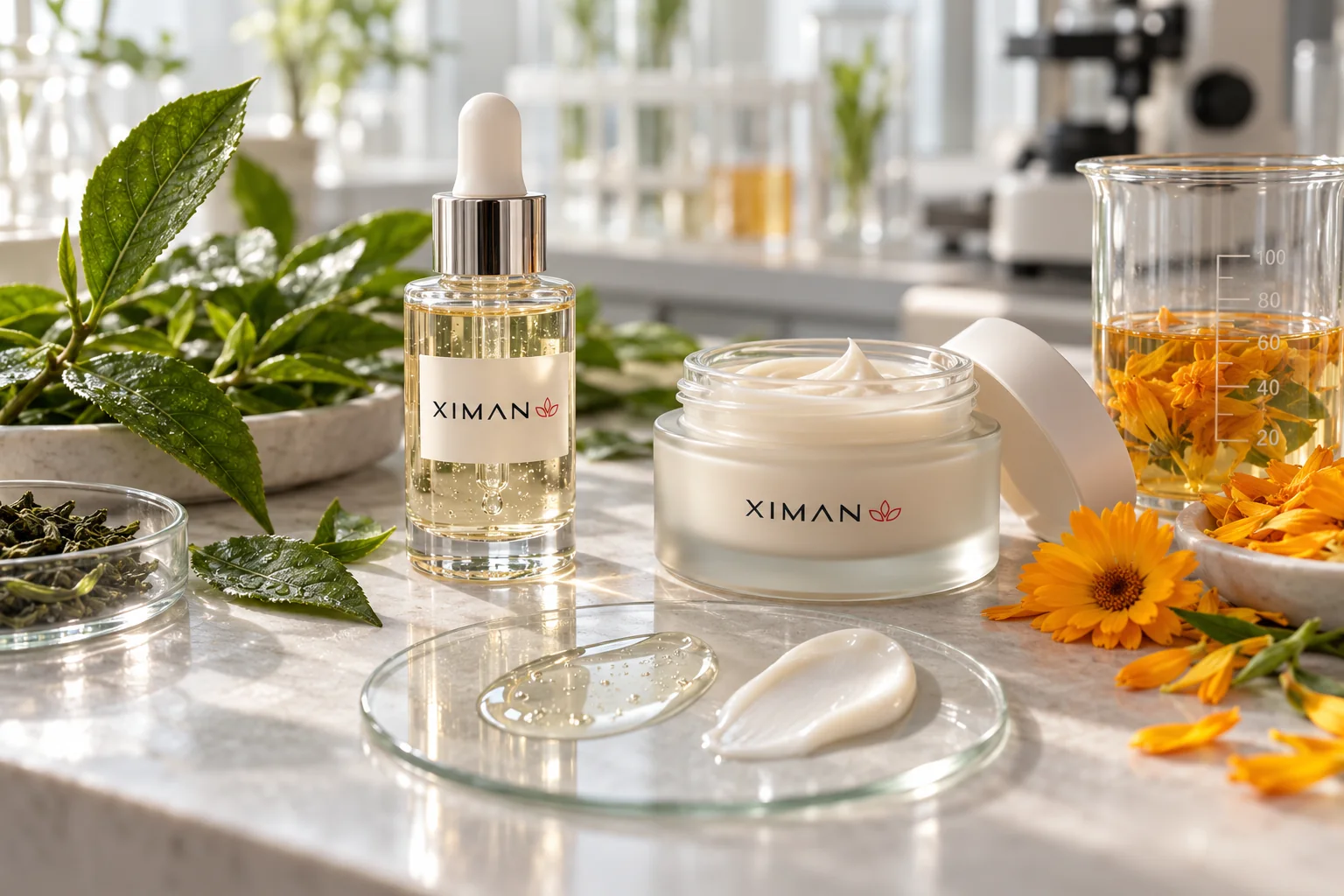
Define the balm experience rather than its appearance alone
A balm brief should explain whether the product is a cleanser, a leave-on moisturizer or another cosmetic format. Specify the desired pickup from the container, softening during application, spread, residual feel and, for a cleansing balm, behavior when water is added. These requirements guide the structure needed in the formula.
A sample can look smooth in a photograph while being difficult to scoop in a cool room or too soft during transport. Establish the relevant temperature range, application tool and pack before approving the sensory target. A compact stick and a wide-mouth jar place different demands on the same material.
Water-free describes the formulation concept. It does not establish ingredient purity, freedom from contamination or suitability for every consumer. The actual composition and intended use still need an appropriate safety and quality assessment. [1]
Investigate graininess through material and process history
Some balm systems can develop visible or perceptible crystals as their structure changes. The technical team should investigate the actual materials, heating and cooling history, mixing, filling and storage conditions before selecting a corrective action. Graininess is an observation, not a complete diagnosis.
Record when the change appears: immediately after filling, after several days, following a temperature excursion or only after repeated opening. Compare affected and unaffected samples with the same formula and pack identity. If a new raw-material lot was introduced, examine its relevant characteristics alongside process records.
Do not assume that reheating a returned sample proves the commercial batch is suitable for rework. A revised process needs its own assessment, and disposition belongs within the manufacturer's documented quality system. Changes in structure can affect dispensing and the consumer experience even if the ingredient list stays unchanged.
Make the cooling and filling window reviewable
Discuss how the process maintains uniform composition through transfer and filling. A partly solidified bulk or long delay before filling can create practical difficulties different from those seen in a small development beaker. The selected manufacturing conditions should be justified for the specific formula and equipment.
| Observation | Question for the development team |
|---|---|
| Uneven surface after setting | What changed in filling and cooling conditions? |
| Visible grains after storage | Which material and temperature histories are relevant? |
| Oil appearing at the surface | Has the structure or composition become nonuniform? |
| Product difficult to pick up | Is the target texture appropriate at the use temperature? |
| Variation across filled units | Was the bulk maintained consistently during filling? |
These questions organize an investigation; they are not automatic assignments of cause. A controlled trial should change a limited set of variables so the results can guide a reliable revision.
Challenge the pack with the actual balm
Assess oil contact with seals, decoration and liners, as well as leakage and opening. A balm that looks firm when upright can behave differently after warming or when stored on its side. Relevant transport conditions should be agreed rather than replacing the study with an arbitrary extreme exposure.
For sticks, compare extension, retraction, breakage and the condition of the exposed surface. For jars, assess pickup, residue on the rim and closure behavior. An attractive pack should not require an impractical amount of effort to obtain the intended dose.
Claims about portability should reflect the tested configuration. Keep formula and packaging revisions linked so a successful result for one jar is not silently transferred to a different liner or closure.
Consider moisture introduced by the consumer
A water-free product may encounter wet hands, bathroom humidity or water remaining in the container. Assess foreseeable use together with formulation characteristics and the safety review. Whether a preservation strategy or specialized microbiological assessment is needed depends on the actual system, not on a blanket rule that all balms require or never require a preservative.
FDA identifies consumer handling and inadequate protection among possible routes of cosmetic contamination. That is a reason to assess the intended use and pack, not proof that a particular balm is contaminated. [2]
Instructions should support the evaluated routine without relying on unrealistic consumer behavior to compensate for a weak design. If an applicator is supplied, evaluate how it is stored and used rather than treating its presence as a hygiene guarantee.
Frequently asked questions
Does graininess mean every balm is unsafe? No. It is a quality observation that needs investigation alongside composition, storage, process and relevant safety information. Appearance alone does not settle disposition.
Can a jar balm be converted directly into a stick? The new format needs assessment of structure, pickup, mechanical integrity, dispensing and packaging. The same ingredient list does not guarantee equivalent performance.
Do all water-free balms need no preservative? No universal conclusion applies. Product characteristics and foreseeable water exposure should be evaluated by qualified technical and safety teams.
Project discussion: Show XIMAN the balm's intended application, temperature conditions and package so texture development can be connected to manufacturing and use.
Sources & review date
- [1] FDA Product Testing of Cosmetics ↗ · Checked 2026-10-14
- [2] FDA Microbiological Safety and Cosmetics ↗ · Checked 2026-10-14
- [3] ISO 22716 Cosmetics good manufacturing practices overview ↗ · Checked 2026-10-14
Sources and check dates are listed above; applicability depends on the destination market and product conditions.
Discuss your market and product
Share your destination market, product category, project stage and estimated quantity to plan the next step.